

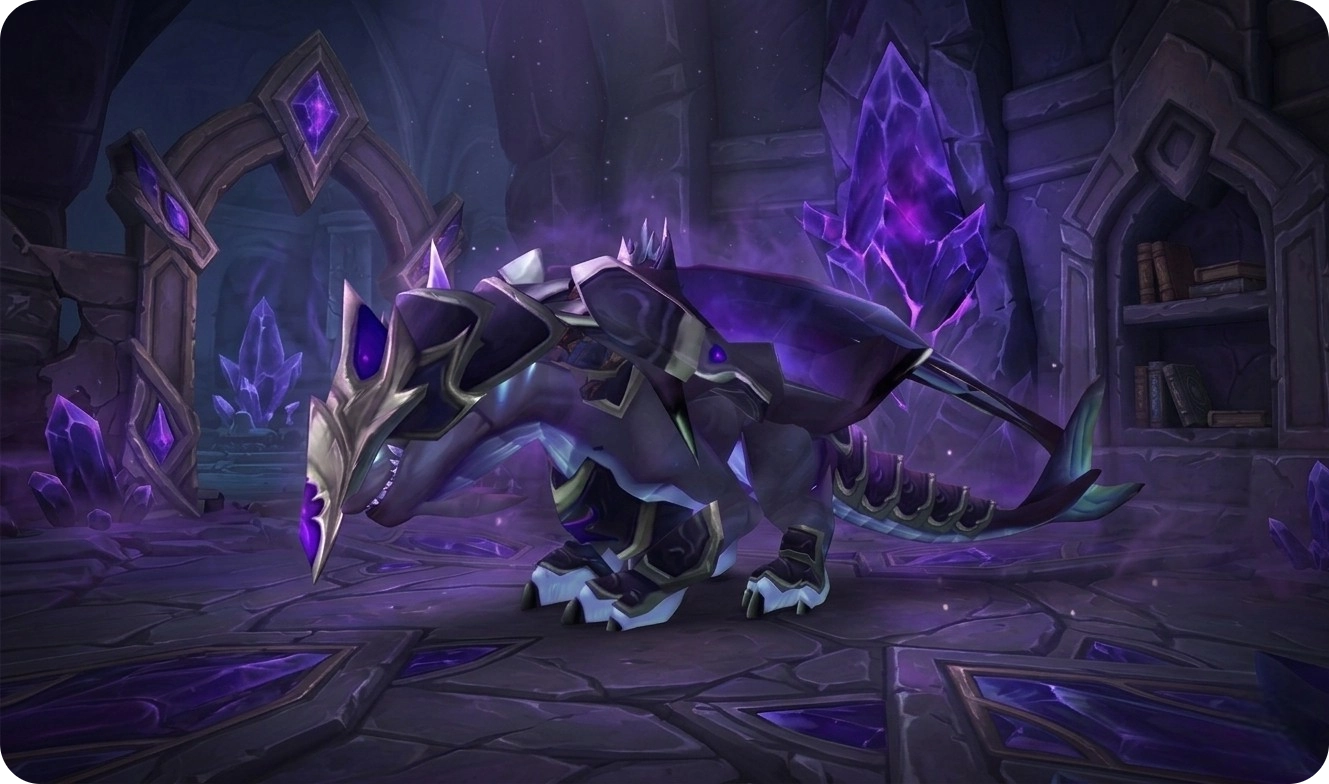
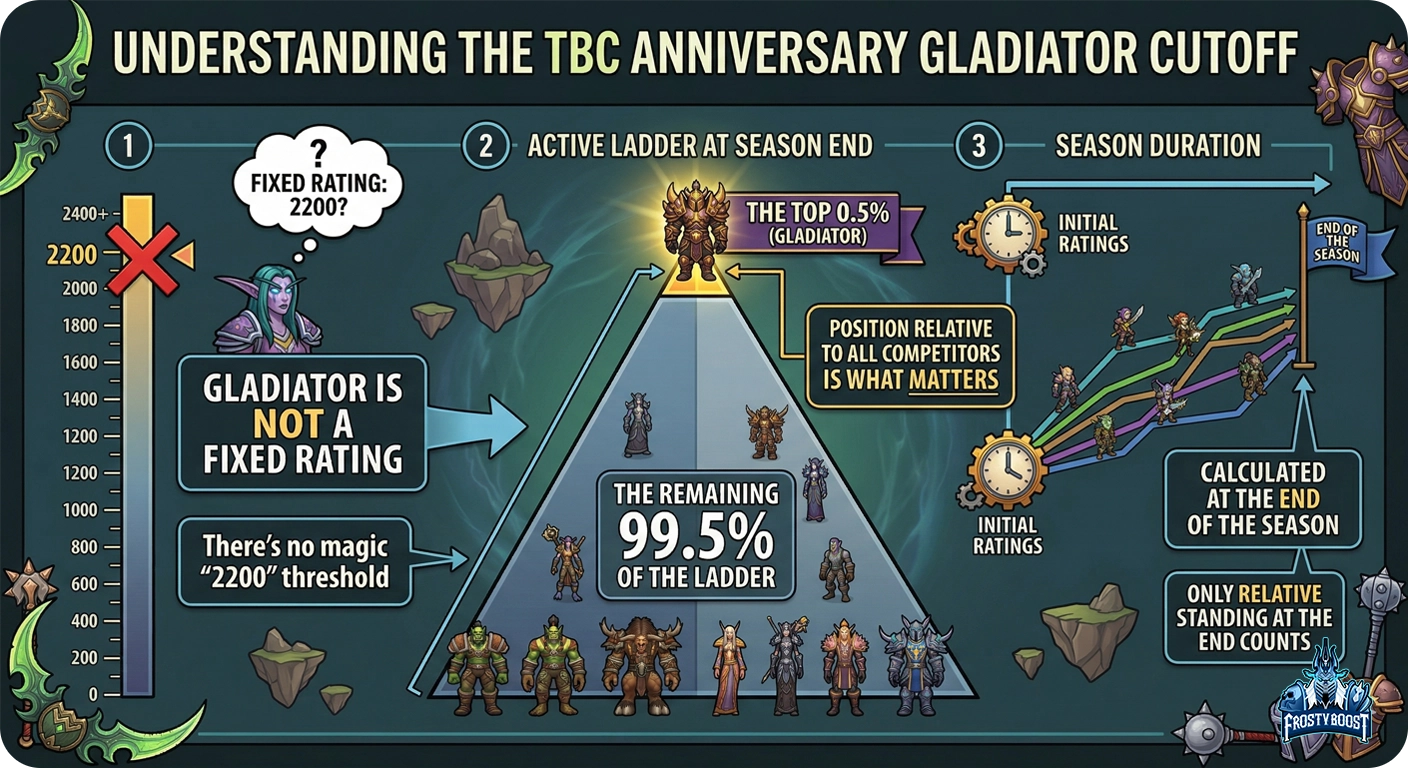
Gladiator in TBC Anniversary is the seasonal title awarded to the top 0.5% of each arena bracket at season end, along with the Swift Nether Drake — the fastest mount in the game at 310% flight speed. There is no fixed rating that earns it. Your place depends entirely on where you finish relative to everyone else still queuing when the season closes.
That single mechanic shapes every decision below: which bracket to push, which comp to run, what gear to have ready, and when to start. If you already know you want the title and only need the fastest route to it, that’s what a TBC Gladiator Boost covers — everything below explains what it takes to do it yourself. Here’s the honest version of all four, including why the Anniversary ladder is harder than the 2007 original and what that means for a player with a job.
 ⤢ Click to enlarge
Gladiator at a Glance
How Is the TBC Gladiator Cutoff Decided?
The Gladiator cutoff is a percentile, not a rating. At the end of the arena season, the top 0.5% of teams in each bracket receive the title and the Swift Nether Drake. A 2200 rating might comfortably clear the cutoff one season and miss it entirely the next, because the only number that matters is your position on the final ladder.
On Anniversary servers, three factors make that percentile unusually expensive to reach.
- A compressed skill floor. The Anniversary ladder pulled in private server veterans, TBC Classic players and returning raiders simultaneously. The average opponent is far more experienced than the 2007 population was at the same point in a season.
- The final surge. In the last two weeks, everyone saving their push queues at once. The cutoff commonly inflates by 50 to 150 rating points in a matter of days.
- No free wins at high MMR. Once you’re near the bracket, every game is a coordinated match against a practiced team. Random victories stop happening entirely.
The practical consequence: pushing early is cheaper than pushing late. Rating gained in the first half of a season costs fewer games than the same rating gained during the final scramble.
 ⤢ Click to enlarge
Is 2v2 or 3v3 Better for a Gladiator Push?
3v3 is the better bracket for reaching the top 0.5% in TBC. More players on the field means fewer hard counters, and a third teammate gives skilled play room to decide games that a bad matchup would otherwise settle on its own.
The 2v2 Bracket
Twos are the most accessible bracket to queue and the most punishing to climb consistently. The format is dominated by comp matchups — one well-played counter can wall you out for an entire session. Dampening games routinely stretch to 10 or 15 minutes, grinding both players down mentally. Progress in 2v2 is rarely linear.
The 3v3 Bracket
Threes reward preparation and coordination in a way twos do not. With three roles interacting, no single enemy composition shuts you down completely, and MMR growth tends to be steadier. That predictability is exactly what a percentile push needs.
Which Comps Are Best in TBC Anniversary Arena?
The strongest compositions in TBC Anniversary are RMP and WLD in 3v3, and Warrior/Druid, Rogue/Druid, Rogue/Mage and Priest/Rogue in 2v2. Here’s how they compare:
| Bracket | Comp | Why It Works | Difficulty |
|---|---|---|---|
| 3v3 | RMP — Rogue / Mage / Priest | The gold standard: best burst, best crowd control, highest coordination ceiling in the game | Very high |
| 3v3 | WLD — Warrior / Warlock / Druid | Sustained pressure with strong peel and layered defensives, effective into a wide pool of setups | Moderate |
| 2v2 | WD — Warrior / Restoration Druid | Relentless damage paired with sustain that outlasts most kill attempts | Moderate |
| 2v2 | RD — Rogue / Restoration Druid | Sustained control and exceptional survivability, one of the hardest pairs to kill at high MMR | High |
| 2v2 | RM — Rogue / Mage | Explosive burst and deep CC chains, with little margin for error | Very high |
| 2v2 | PR — Priest / Rogue | Burst control into tight kill windows, punishing against disorganized teams | High |
What Gear Do You Need Before Pushing Arena in TBC?
PvP gear alone isn’t enough at the Gladiator bracket in TBC. Several PvE and crafted items outperform their arena equivalents by a wide margin, and high-MMR opponents already have them. This is the preparation most players underestimate.
 ⤢ Click to enlarge
Warriors
- Deep Thunder (Blacksmithing) — the best available weapon in early phases. Its stun proc and raw stats significantly outperform PvP alternatives at the same gear level.
- Stormherald (Blacksmithing upgrade) — the late-phase replacement, upgraded directly from Deep Thunder. The power spike translates straight into kill pressure and becomes effectively mandatory for high-rating pushes.
Healers
- Bangle of Endless Blessings — critical for Priests and other healers with strong Spirit scaling. In long dampening games, the mana it returns is the difference between surviving the match and going out of mana at the worst moment.
Restoration Druids
- Idol of the Emerald Queen — close to mandatory. It substantially increases Lifebloom throughput, and Lifebloom is the foundation of the entire Restoration Druid arena kit.
Addons and setup
- Gladius — enemy unit frames and diminishing returns tracking.
- OmniBar — visibility on enemy cooldowns.
- Focus macros and interrupt keybinds — every interrupt and CC should fire without menu navigation.
Farming the gear and configuring the setup takes weeks, and all of it happens before your first serious rated game.
Why Is Finding Arena Partners So Hard on Anniversary Servers?
The hardest part of a Gladiator push on Anniversary servers isn’t mechanical skill — it’s access to practiced teammates. A large share of the strongest players arrived from private servers that had been running for years, and they arrived with their teams already formed.
Those players spent thousands of hours on TBC specifically: frame-perfect kick timings, exact diminishing returns windows, full CC chains from muscle memory. More importantly, the Rogue who dominated a private server ladder already has his Mage and Priest. Recruiting him into a new team isn’t a realistic proposition for most players.
That leaves the rest of the ladder made up of three groups:
- Players who loved TBC in 2007 and came back for the experience.
- Players who chased Gladiator in TBC Classic and returned to finish the job.
- Retail players with strong fundamentals who need to relearn TBC-specific mechanics fast.
None of these groups lack skill or commitment. What they lack is the pre-built social infrastructure the private server veterans brought with them. Queuing with motivated but unconnected partners against synchronized, long-established teams is a structural disadvantage, not a personal failure.
Which Path to Gladiator Makes Sense for You?
There are three realistic routes to the top 0.5% in TBC Anniversary, and the right one depends on how much time you can commit rather than how good you are.
| Path | What It Demands | Best For |
|---|---|---|
| Build your own team | 15+ hours a week, a stable roster of two or three equally committed players, gear farmed on every character | Players with an existing group and a flexible schedule |
| Push with pickup partners | Long sessions in the 1500-2100 MMR range with inconsistent teammates, restarting whenever someone leaves | Players with time to spare and no fixed group |
| Have professionals push the account | Gear preparation and the ladder climb handled by players already competing at the cutoff | Players who want the title and mount but can’t commit the hours |
If your limiting factor is time rather than ability, the 1500-2100 MMR trench with rotating pickup partners is the worst place to spend it. Nothing about that stretch teaches you the bracket you’re aiming for, and the cutoff keeps climbing while you’re in it. For players in that position, a TBC Anniversary Gladiator Boost is the realistic path — the push is executed by players who already know the compositions, the timings and the current cutoff.
Start Early or Pay Later
Gladiator in TBC Anniversary is a real, achievable goal. The mount exists, the cutoff is knowable, and the meta is solved and public. The only open question is which path you take, and how early you start walking it.
The season won’t last forever, and the cutoff only moves in one direction. Every week spent deciding is a week the ladder spends climbing — and the final fortnight is the most expensive time to enter it.